

Electric Cylinder vs Hydraulic Cylinder vs Pneumatic Cylinder: A Comprehensive Comparison – Who is the True King of Cost-Effectiveness?
In the field of industrial automation, the three main types of linear motion actuators are hydraulic cylinders, pneumatic cylinders (air cylinders), and electric cylinders (electromechanical actuators). Hydraulic cylinders offer massive force, pneumatic cylinders provide fast response, and electric cylinders—as a rising star—are rapidly replacing traditional hydraulic and pneumatic solutions. With advantages like high precision, low maintenance, and energy efficiency, electric cylinders represent an irreversible trend in industry development.
So, what are the fundamental differences between these three actuator types? Why are electric cylinders becoming the dominant replacement? And from a total lifecycle cost perspective, which one offers the best value?
This article provides an in-depth comparison of technical parameters, performance, and cost of ownership, revealing the leading advantages of Jiangsente Electric Cylinders.
Part 1: Why Electric Cylinders are Becoming the "Replacement" Solution

1. Core Differences & Advantages/Disadvantages
1.1 Major Differences in Drive Principles
-
Electric Cylinder: Pure electric drive. Uses a servo motor + ball screw/roller screw to directly convert rotary motion into linear mechanical motion. Requires no additional external power units.
-
Pneumatic Cylinder: Driven by compressed air. Requires a supporting air compressor, air lines, and air preparation system.
-
Hydraulic Cylinder: Driven by hydraulic fluid. Requires a complete hydraulic power unit (pump station), valve blocks, and hydraulic piping.
1.2 Control Performance: Electric Leads Comprehensively
Electric cylinders outperform traditional pneumatic and hydraulic cylinders in precision, force control, and speed.
-
Precision: Standard electric cylinders typically have a repeat positioning accuracy of ±0.02mm to ±0.05mm. Jiangsente models can achieve up to ±0.005mm, far exceeding the typical ±0.5mm for pneumatic and ±1mm for hydraulic systems.
-
Control: Supports precise force control and stepless speed regulation. Operation is smooth with no impact shock.
-
Pressure Holding: Maintains pressure stably and reliably. Features mechanical self-locking upon power loss, completely solving the common industry pain points of air/oil leakage and unstable pressure holding.
1.3 Structure & Maintenance: Far Simpler
-
Electric Cylinder: Compact, integrated design. Simple installation. Requires only periodic grease replenishment; almost maintenance-free.
-
Pneumatic Cylinder: Complex piping with multiple potential leak points. Requires frequent maintenance of the air source system.
-
Hydraulic Cylinder: Bulky system prone to oil leaks. Requires regular oil changes and seal replacement. High maintenance cost.
1.4 Energy Consumption & Long-Term Cost: A Clear Advantage
-
Electric Cylinder: Transmission efficiency is 75%–95%. Consumes energy only on demand, with annual energy use as low as 1–5 kW·h.
-
Hydraulic Cylinder: System efficiency is approximately 40%–60%.
-
Pneumatic Cylinder: Efficiency is only 10%–30%.
Due to leakage losses and continuous energy draw, the energy consumption of hydraulic and pneumatic systems can be several times higher than that of electric cylinders, resulting in significantly higher long-term operating costs.
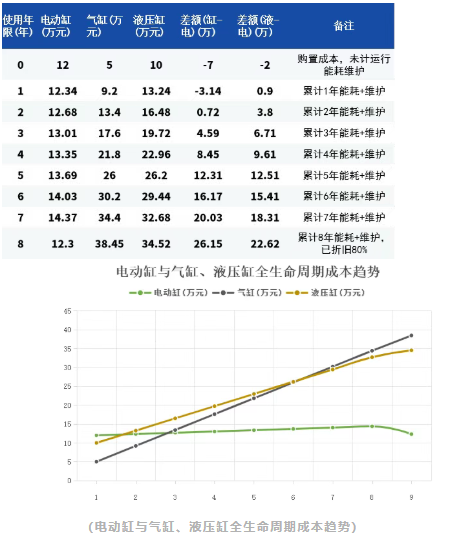
2. Lifecycle Cost Comparison (Table & Trend)
Trend Analysis: Although electric cylinders have a higher initial purchase price, their low energy and maintenance costs make them the most cost-effective option within 2-3 years of operation compared to pneumatic systems, and immediately or soon after compared to hydraulic systems.


3. Jiangsente Electric Cylinder vs Hydraulic vs Pneumatic: At-a-Glance Comparison
Part 2: Jiangsente Electric Cylinder's Core Advantages

As a professional manufacturer, Jiangsente continuously pushes performance boundaries with industry-leading technologies, offering four core advantages:
1. Industry-Leading Performance Parameters
-
Superior Force: Maximum thrust up to 500 tons, leading the domestic industry and covering all heavy-load scenarios.
-
Ultra-High Precision: Highest repeat positioning accuracy of ±0.005mm, exceeding the industry standard of ±0.02–0.05mm.
-
Extended Lifespan: Standard models can be reused over 10 million times; stable operation for over 5 years in medium-duty conditions.
-
Robust Protection: Customizable IP68 protection against dust, water, and corrosion, exceeding standard industry specs.
2. Flexible Adaptation to Non-Standard Automation
-
High Precision: Meets demands of automated production lines and machining.
-
Stepless Speed Control: Adapts to 3D printing, high-speed sorting, etc.
-
Complex Motion: Supports multi-mode control for multi-DOF platforms and multi-stage cylinders.
3. Low Consumption & High Long-Term Value
-
High Efficiency: High electrical conversion efficiency reduces energy consumption. Stable operation even in high-temperature workshops.
-
Low Maintenance: Simple structure minimizes upkeep, saving significant OPEX.
-
Slow Performance Degradation: High residual value in the secondary market. Excellent total cost of ownership (TCO).
4. All-Scenario Adaptability & Safety
-
Harsh Environments: Suitable for extreme cold, heat, humidity, and heavy dust (mining, scientific research, factories).
-
Safety Systems: Built-in overload protection and fault预警 systems ensure stable, continuous production.
Part 3: Conclusion – The Needs of a New Era

As industrial automation moves towards intelligence and sustainability, electric cylinders are progressively replacing traditional hydraulic and pneumatic systems. Their advantages in precision, energy efficiency, maintenance-free operation, and environmental cleanliness make them the superior choice.
While the initial investment in an electric cylinder is slightly higher than a standard pneumatic/hydraulic cylinder, it is far lower than a high-performance servo-hydraulic system. From a total lifecycle cost perspective, the electric cylinder is undoubtedly the more cost-effective solution.
Jiangsente Electric Cylinders, with their exceptional performance and reliable quality, are here to help your automated production lines reduce costs and increase efficiency.

Contact Jiangsente
-
Brand: JSTKJ
-
Tel: 400-996-7600
-
Website:
-
Agent Service Hotline: 15850272155